
Site Selection Success: A Demographic Deep Dive
Why Demographics are the Bedrock of Site Selection

Demographic site analysis is the evaluation of statistical data about populations in specific geographic areas to make informed business location decisions. This data-driven approach examines factors like population trends, economic indicators, age, education, and lifestyle patterns to determine if a location aligns with your target market.
According to research from Henry Schein Financial Services, demographic site analysis reports provide "valuable information about specific practice-location sites" that can mean "the difference between the success and failure of your future enterprise." The data helps businesses tailor inventory, design customer experiences, refine marketing, and forecast performance with remarkable precision.
For example, knowing that high-income households nearly doubled between 2010 and 2020 helps luxury retailers identify expansion opportunities. Similarly, understanding that areas with young families support toy stores while elderly populations drive demand for healthcare services enables strategic site selection.
When demographic analysis is overlooked, businesses face costly missteps including pricing misalignment, poor traffic, and overall venture failure. As retail expert Mike Cavender notes, successful site selection requires making complex decisions simple without hiding behind "black-box models that are hard to trust."
I'm Clyde Christian Anderson, Founder and CEO of GrowthFactor.ai. My experience scaling retail operations has taught me that demographic intelligence is the foundation of every successful location decision, and I've helped retailers open up $1.6M in cash flow through data-driven expansion strategies rooted in this analysis.
For a deeper dive into how data transforms site selection, explore our insights on Data-Driven Site Selection.
The Core Components of a Winning Demographic Site Analysis

Effective demographic site analysis transforms guesswork into strategic, data-driven decisions. Think of it as a business GPS, guiding you to the ideal location where your target customers live, work, and shop. A robust analysis reveals whether a site is a goldmine or a money pit by examining population density, age, income, and lifestyle patterns.
This data is the foundation for critical moves like market entry, expansion, or optimizing existing locations. For any business—from retail and restaurants to healthcare—this intelligence is essential. It allows you to tailor inventory, menus, and pricing to local preferences and spending power. By understanding your customer base, you can forecast performance, refine marketing, and design custom experiences that drive sustainable growth.
Key Demographic Indicators to Analyze
Effective analysis pieces together clues about a community's character. These key indicators tell the story:
- Population Density: Indicates the number of potential customers. A dense urban block may suit a coffee shop, while a suburban area is better for a large furniture store.
- Age Distribution: Predicts consumer needs. Young families support toy stores, while retirees drive demand for healthcare services.
- Income Levels: Reveal spending power. The recent growth in high-income households, for example, creates opportunities for luxury brands.
- Household Composition: Shapes purchasing. Homeowners buy more home goods than renters, and large families have different needs than singles.
- Education Levels: Influence taste and brand loyalty. Highly educated populations often support specialty retailers and premium services.
- Employment Data: Shows community character. The local job landscape (e.g., white-collar vs. blue-collar) helps predict shopping habits.
- Commuter Patterns: Reveal customer flow. High foot traffic near transit is ideal for convenience-based businesses.
For deeper insights into maximizing location potential, explore our analysis of High Foot Traffic areas.
Finding Reliable Data for Your Demographic Site Analysis

Great demographic site analysis starts with rock-solid data. We blend public and private data sources to create the most complete picture possible.
Public data sources like the U.S. Census Bureau serve as our foundation. They provide a treasure trove of data on employment, education, income, and more, often down to the block group level. The Bureau of Labor Statistics adds another layer with its Consumer Expenditure Survey (CEX), showing how households spend money.
Private data providers improve this foundation with proprietary models and real-time updates. They integrate information from consumer spending, mobility data, and other sources to create richer, more nuanced community portraits.
At GrowthFactor, we integrate data from multiple top-tier providers. Our platform automatically updates this data quarterly, ensuring our clients always work with current, accurate, and complete information. The magic happens when we combine the robust foundation of public data with detailed insights from private providers, giving our clients the most precise and actionable analysis possible.
For more information about the comprehensive data we leverage, visit our insights on Site Selection Data.
Demographics vs. Lifestyle Data: A Powerful Combination
Understanding your customers requires knowing both who they are (demographics) and how they live (lifestyle). At GrowthFactor, we've found that the real power of demographic site analysis comes from combining these two data types.
Demographic data answers the "who" with quantifiable stats like age, income, education, and household size. Lifestyle data (or psychographics) digs into the "why" behind consumer behavior, revealing interests, shopping habits, values, and daily activities.
For example, demographics might identify a neighborhood of "high-income young families." Lifestyle data reveals if they are "eco-conscious tech enthusiasts" or "convenience-focused professionals." This distinction is critical.
This combination enables precise business decisions. You can tailor product offerings, design customer experiences, and craft marketing messages that resonate with specific values and habits. While lifestyle segmentation systems provide valuable frameworks, we remember they are snapshots in time and continuously monitor for shifts.
Instead of generic assumptions, we deliver precise insights that drive real results. Learn more about our advanced consumer segmentation capabilities and how we combine these powerful data sets.
From Data to Decisions: Applying Demographic Insights for Growth
Gathering demographic and lifestyle data is just the first step. The real value comes from turning those numbers into a winning business strategy. At GrowthFactor, we help you use demographic site analysis to make smart decisions that drive growth and give you a competitive edge.
Demographic insights provide the roadmap for everything from forecasting sales and refining marketing to designing the perfect customer experience and tailoring your inventory. Knowing the age, income, and cultural background of your community allows you to stock the right products at the right prices and provide service that feels relevant. This moves you from broad guesses to precise, data-backed strategies, letting you tailor every aspect of your business with surgical precision.

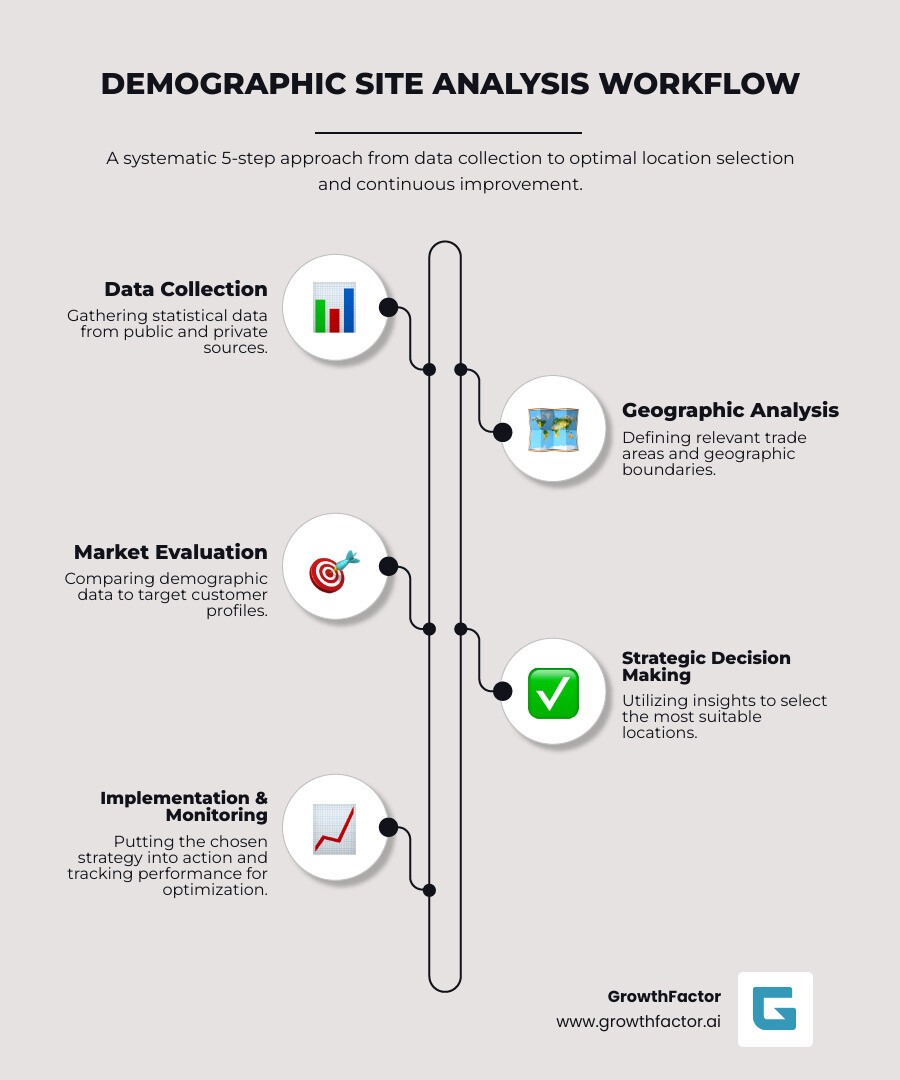
A Practical Guide to Demographic Site Analysis
Whether you're launching your first location or expanding an enterprise, a solid approach to demographic site analysis is critical.
- Start with your ideal customer. Before looking at locations, get clear on who you serve. Define their age, income, family status, and values. This profile is your North Star.
- Scout potential locations. Use a modern platform to quickly spot neighborhoods that match your broad demographic filters.
- Dive deep into the data. For each promising spot, pull detailed reports on population density, growth, age, income, and more. Compare this to your ideal customer profile.
- Go beyond the basics with lifestyle data. Understand what people do with their time and money. A portrait studio, for example, needs high-income families who value capturing memories.
- Calculate spending potential. Use data from sources like the Consumer Expenditure Survey to see how much local households spend on products like yours.
- Size up the competition. Analyze how many similar businesses are nearby to determine if the market is saturated or has room for a new player.
- Map your trade area. Understand where customers will come from, considering commuter patterns and accessibility. GIS tools can help visualize this.
- Project your future. Use demographic insights to forecast performance and build a solid, data-driven business plan that investors will take seriously.
Our platform helps you evaluate multiple locations efficiently to pick the best site for long-term success. For deeper insights into retail location strategies, check out our guide on Retail Location Analysis.
The Role of AI and Big Data in Modern Analysis
The world of demographic site analysis has been transformed by big data and artificial intelligence. What once took weeks of manual work can now be done in minutes with greater accuracy.
AI, particularly through predictive algorithms, is revolutionizing how we use demographics. Our AI Agent Waldo harnesses this technology to boost your site selection process. Waldo automates the heavy lifting, sifting through massive datasets to identify and qualify potential sites that match your specific needs.
The efficiency gains are remarkable. With AI Agent Waldo, our clients can evaluate five times more sites than traditional methods allow, providing a critical speed advantage in a competitive market. AI also uncovers hidden insights that human analysts might miss, spotting subtle patterns in data to predict consumer behavior, forecast foot traffic, and assess how demographic shifts might impact future demand.

This fusion of AI and big data turns demographic analysis into a forward-thinking, predictive tool. You're not just understanding an area today—you're anticipating how the market will evolve. Our AI-improved platform leads this revolution, offering cutting-edge AI Location Intelligence to help you stay ahead of the curve.
Pitfalls to Avoid and Future-Proofing Your Strategy
Even with powerful tools, missteps in demographic site analysis can lead to pricing misalignment, poor traffic, or business failure. Here are common pitfalls to avoid:
- Don't rely on gut feeling alone. Your experience is valuable, but it can't replace solid data.
- Keep your data fresh. Demographics shift constantly; last year's data can be dangerously outdated.
- Look at the full customer mix. A high average income doesn't help if residents prefer to shop online for your product.
- Consider all demographic factors, not just one or two. A lower-income area might be perfect for a discount retailer.
To future-proof your strategy, consider long-term demographic shifts. The aging U.S. population, for example, is driving demand for healthcare and related services. AARP research shows most older adults want to age in place, creating specific local opportunities. Climate change impacts will also reshape where people live and work, affecting regional economic viability.
Our AI-improved platform helps you avoid these pitfalls by providing comprehensive, up-to-date data. Our tools monitor demographic changes so you can build a resilient strategy for lasting success.
Ready to transform your site selection with data-driven insights? Explore our all-in-one real estate platform and find how AI Agent Waldo can revolutionize your expansion strategy.
Frequently Asked Questions
What is site demographics?
Effective demographic site analysis transforms guesswork into strategic, data-driven decisions. Think of it as a business GPS, guiding you to the ideal location where your target customers live, work, and shop.
What are the main benefits of site demographics?
According to research from Henry Schein Financial Services, demographic site analysis reports provide "valuable information about specific practice-location sites" that can mean "the difference between the success and failure of your future enterprise." The data helps businesses
How does site demographics work in practice?
Demographic site analysis is the evaluation of statistical data about populations in specific geographic areas to make informed business location decisions.
What specific demographic variables are most predictive of retail site performance?
Median household income, population density, age distribution, household size, and consumer spending patterns in the relevant retail category are consistently the most predictive site demographics for retail success. The relative importance of each variable shifts depending on the brand's customer profile and price positioning, which is why demographic models should be calibrated against existing store performance rather than using generic industry benchmarks.
How do you source reliable site demographics data for a location analysis?
Reliable sources include U.S. Census Bureau data through American Community Survey updates, commercial data providers that enhance census data with consumer spending estimates and psychographic overlays, and aggregated mobile device datasets that reflect actual consumer behavior patterns. Most site selection platforms integrate multiple data sources and apply geographic weighting to produce trade area-level demographic summaries.
How often is site demographics data updated and why does data freshness matter?
Census-derived site demographics data is typically updated annually by commercial providers using statistical modeling between decennial censuses, while mobility-based behavioral data can be refreshed monthly or even weekly depending on the vendor. Data freshness matters because markets change—neighborhoods gentrify, new residential development shifts income profiles, and population migration alters the consumer base a location serves.
What is the difference between ring analysis and drive-time analysis in site demographics?
Ring analysis measures site demographics within fixed-radius circles around a location (e.g., 1-mile, 3-mile, 5-mile), while drive-time analysis uses actual road network data to define zones based on realistic travel time rather than straight-line distance. Drive-time analysis typically produces more accurate trade area demographic profiles because geographic barriers like rivers, highways, and urban density create real asymmetries in customer accessibility.
How do site demographics inform decisions about store format and product assortment?
Site demographics reveal whether the local population skews toward families or singles, luxury or value shoppers, young or older consumers—insights that directly inform format size, product mix, and price positioning decisions for that specific location. Retailers who localize their assortment and format based on site demographics rather than applying a chain-wide standard typically see higher conversion rates and customer satisfaction scores.
How should site demographics analysis account for daytime versus residential population?
Daytime population—workers, commuters, and students who spend significant time near a location during business hours—can exceed residential population by a large factor in urban and employment-dense areas, fundamentally changing the demand profile for time-sensitive formats. Site demographics analysis that includes daytime population alongside residential data produces more accurate demand estimates, particularly for quick-service, convenience, and lunch-oriented retail.
How does psychographic segmentation enhance traditional site demographics analysis?
Psychographic data layers consumer lifestyle attributes, values, and shopping behavior patterns onto the demographic foundation, helping retailers understand not just who lives in the trade area but whether those consumers are likely to be brand-relevant shoppers. This additional dimension of site demographics analysis is especially valuable for specialty retailers and premium brands whose customer profile is defined as much by mindset as by income or age.
Citations
The human algorithm
Request Your demo
Schedule meeting
Or submit your information below and we'll be in touch to schedule.